
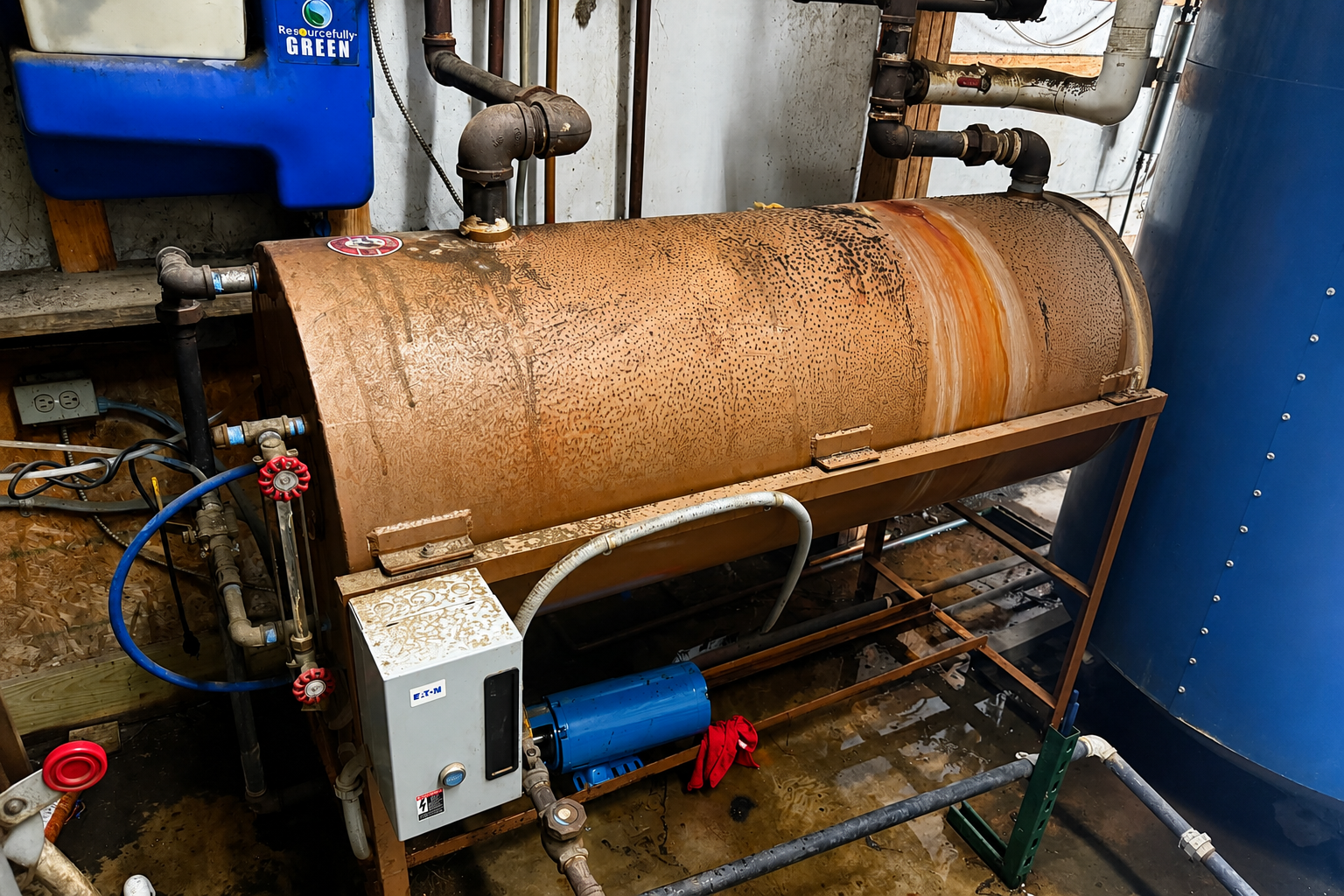
A leaking condensate tank or boiler feed tank can quickly lead to boiler room flooding, increased makeup water consumption, equipment damage, and unexpected downtime. Fortunately, a leaking tank does not always require replacement of the entire system.
If your condensate tank, boiler feed tank, return tank, or makeup water tank is leaking, rusted, or showing signs of failure, the tank may be replaceable while reusing existing pumps, motors, controls, and piping connections. Facilities evaluating a replacement should review both our replacement condensate return tanks and complete condensate / boiler feed systems to determine the best solution.
Rema LLC manufactures replacement condensate return tanks and boiler feed tanks in steel and stainless steel. Most replacement tanks are built to order and typically ship in 1-2 weeks. Rush orders may be available depending on current shop schedule.
Need help matching a replacement? Send photos of your existing tank, boiler horsepower, voltage, pump information, and tank dimensions.
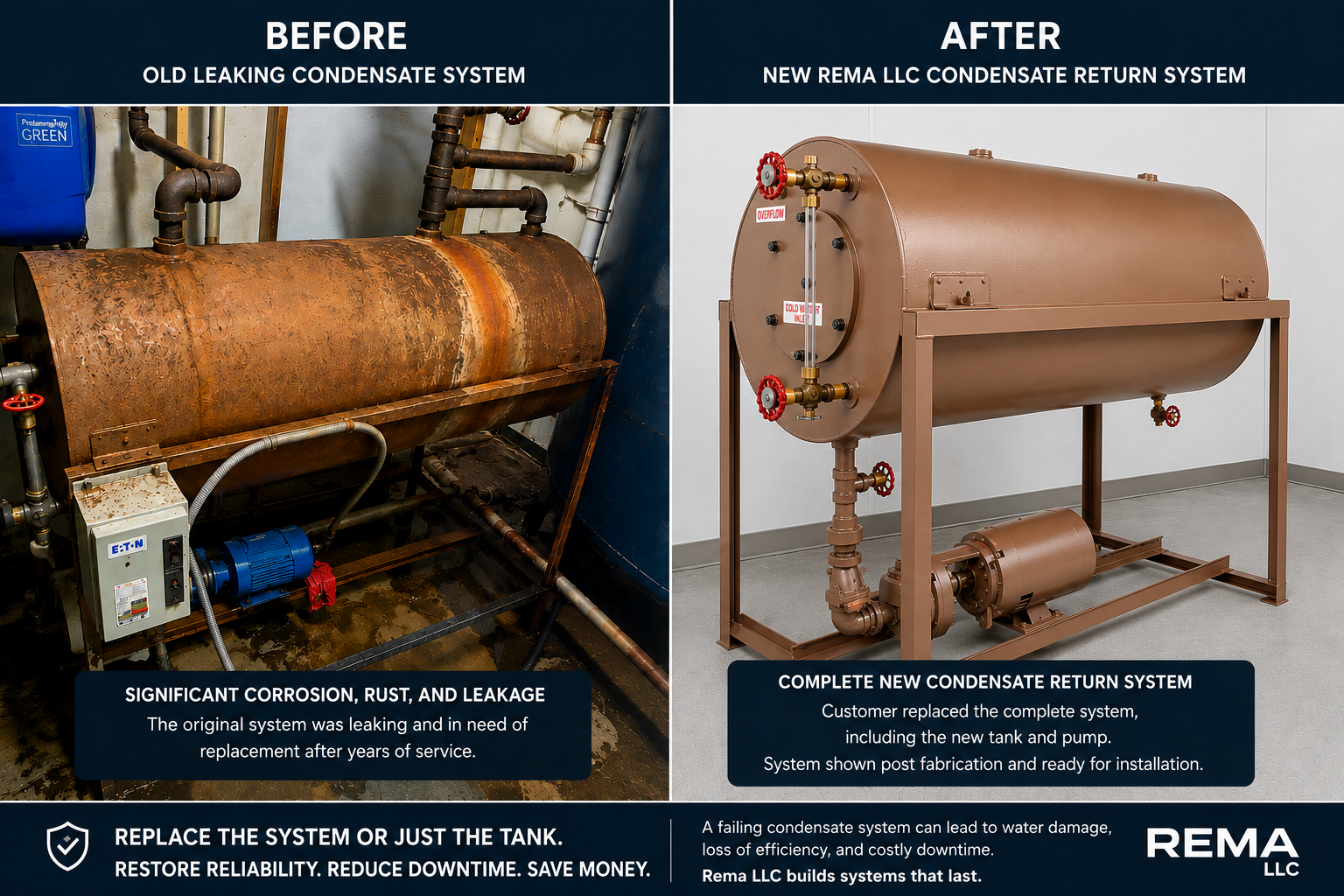
Real-World Condensate / Boiler Feed System Replacement
The images below show a real condensate / boiler feed system replacement project. The original system had experienced years of corrosion and leakage. While some facilities can replace only the tank, this customer elected to replace the complete system, including a new tank and pump.
Quick Replacement Guide
| Problem | Possible Solution |
|---|---|
| Leaking condensate tank | Replace the tank |
| Rusted boiler feed tank | Replace with a new steel or stainless steel tank |
| Working pumps, failed tank | Reuse pumps and controls with a new replacement tank |
| Failed pumps and leaking tank | Consider a complete condensate / boiler feed system |
| Unknown equipment condition | Send photos and nameplate information for review |
Common Signs Your Condensate Tank Is Failing
A leaking condensate tank often starts as a small issue before becoming a major boiler room problem. If the tank is rusted, cracked, or leaking from the bottom or seams, replacement may be necessary.
- Water leaking from the bottom or seams of the tank
- Visible rust, corrosion, or soft spots in the tank
- Repeated boiler room flooding
- Increased makeup water usage
- Frequent pump cycling
- Condensate return or boiler feed pumps operating normally while the tank continues to leak
- An aging tank that has already been repaired multiple times
Can You Replace Just the Tank?
In many situations, yes. If the pumps, motors, controls, and piping connections remain in good condition, replacing only the condensate tank or boiler feed tank may be the most cost-effective solution.
This approach can reduce replacement cost, minimize downtime, preserve working components, and extend the life of the overall system.
If the tank does not require replacement, some issues may be resolved with replacement tank parts.
Browse all replacement condensate return tanks
Replace Tank Only vs. Replace the Complete System
| Condition | Replace Tank Only | Replace Complete System |
|---|---|---|
| Tank is leaking but pumps still work | Usually possible | Optional |
| Tank is rusted through | Often possible | Sometimes |
| Pumps are failing | Not ideal | Recommended |
| Controls are unreliable | Not ideal | Recommended |
| System is undersized | No | Recommended |
| Multiple components are worn out | No | Recommended |
When a Complete Condensate / Boiler Feed System May Be Better
Sometimes the leaking tank is only part of the problem. A complete condensate / boiler feed system replacement may make more sense when the existing equipment has multiple issues.
- The pumps are worn out
- The motors are failing
- The controls are unreliable
- The float assembly is damaged
- The existing unit is undersized
- Multiple repairs have already been attempted
- The system is several decades old
Browse condensate / boiler feed systems
Condensate / Boiler Feed Systems vs. Condensate Receiver Systems
In the field, the terms condensate return system, boiler feed system, return system, feed system, makeup tank, and makeup water system are often used loosely. However, the pump control method is important when matching a replacement.
A condensate / boiler feed system is typically controlled by the boiler. When the boiler needs water, the boiler control activates the pump and moves water from the tank to the boiler. The tank receives returning condensate and holds makeup water for boiler feed service.
A condensate receiver system is different. A receiver system typically fills with condensate and pumps out when the tank reaches a set level. If you are unsure which type of system you have, send photos of the tank, pumps, controls, and piping so Rema LLC can help review the application.
Steel vs. Stainless Steel Condensate Tanks
Rema LLC manufactures both steel and stainless steel replacement tanks.
Steel Tanks
Steel condensate tanks are the most common replacement option and provide an economical solution for many boiler rooms.
Steel tanks are commonly used in commercial buildings, schools, apartment complexes, laundries, dry cleaners, and general steam applications.
Browse horizontal steel condensate return tanks
Browse vertical steel condensate return tanks
Stainless Steel Tanks
Stainless steel tanks provide increased corrosion resistance and are often selected where water conditions or operating conditions have shortened the life of the original tank.
Stainless steel may be preferred for food processing facilities, breweries, distilleries, healthcare facilities, and applications where corrosion resistance is a priority.
Browse horizontal stainless steel condensate return tanks
Browse vertical stainless steel condensate return tanks
Industries That Use Condensate Return and Boiler Feed Tanks
Condensate return tanks and boiler feed tanks are used in many commercial and industrial steam applications, not only dry cleaning plants.
- Commercial laundries and linen services
- Dry cleaners and garment finishing plants
- Apartment buildings and multifamily properties
- Schools and universities
- Hospitals and healthcare facilities
- Breweries and distilleries
- Bakeries and food processing facilities
- Manufacturing plants using steam for process heat
- Hotels and hospitality facilities
- Municipal and institutional boiler rooms
What Information Helps Us Match a Replacement Tank?
The more information provided, the faster we can recommend a replacement condensate tank or boiler feed tank.
- Photos of the complete unit
- Photos of the nameplate or tag, if available
- Boiler horsepower
- Voltage and phase
- Tank dimensions
- Horizontal or vertical tank orientation
- Pump model and horsepower
- Preferred tank material
- Ship-to ZIP code
- Desired delivery timeframe
If you are unsure about any of these details, photos are often enough for us to begin evaluating replacement options.
Replacement Parts vs. Tank Replacement
Not every system requires a new tank. If the tank remains structurally sound, replacement parts may be all that is needed.
Common replacement items include floats, gauge glasses, valves, controls, and miscellaneous tank components.
Built-to-Order Replacement Tanks
Most replacement condensate return tanks and boiler feed tanks are built to order. Typical lead time is 1-2 weeks depending on tank size, material, and current production schedule.
Rush orders may be available. If your facility is experiencing an emergency shutdown or active tank failure, contact Rema LLC with photos and dimensions to discuss expedited options.
Not sure whether you need a replacement tank or a complete condensate / boiler feed system?
Send photos of your equipment and our team will review your application.
Request Help Matching a Replacement Tank
Use the form below to send photos, dimensions, boiler horsepower, voltage, pump information, and shipping ZIP code. Most replacement condensate return tanks and boiler feed tanks are built to order and typically ship in 1-2 weeks. Rush orders may be available depending on shop schedule.
Frequently Asked Questions
Can I replace only the condensate tank and keep my existing pumps?
In many cases, yes. If the pumps, controls, and piping remain serviceable, replacing only the tank may be possible.
Do you manufacture boiler feed tanks?
Yes. Rema LLC manufactures replacement tanks for both condensate return and boiler feed applications.
Is a condensate / boiler feed system the same as a condensate receiver system?
Not always. A condensate / boiler feed system is typically controlled by the boiler and pumps water from the tank to the boiler when needed. A condensate receiver system typically fills with condensate and pumps out when the tank reaches a set level.
How long does a replacement tank take?
Most tanks are built to order and typically ship in 1-2 weeks. Rush orders may be available depending on shop schedule.
Should I choose steel or stainless steel?
Steel is the most common option. Stainless steel is often preferred when corrosion resistance is a priority or when the existing tank failed prematurely due to water conditions.
What if I do not know the tank size?
Send photos, boiler information, and approximate dimensions. Rema LLC can often help identify the proper replacement direction from field information.
When should I replace the entire system instead of just the tank?
A complete system replacement may be appropriate when pumps, controls, motors, and other major components are also nearing the end of their service life.